
Agreement to Make Public Unpublished BIA Decisions

Human beings seem to be wired or conditioned to readily believe bad news. It is common to hear people say: “That’s too good to be true.” However, I have never heard anybody say: “That’s too bad to be true.”
Based on a stipulation of settlement filed February 9, 2022, the Board of Immigration Appeals (“BIA”) has agreed to provide access to its unpublished decisions in an electronic reading room (i.e. a website formatted for public inspection pursuant to 5 U.S.C. § 552(a)(2)(A)). See document 72 filed in New York Legal Assistance Group v. The Board of Immigration Review and the Department of Justice (U.S. District Court, Southern District of New York) Case No. 18 Civ. 9495 (PAC).
This news might strike some as too good to be true, but nevertheless it apparently is true.
To view the complete settlement agreement copy and paste the following link in your internet browser: https://www.citizen.org/wp-content/uploads/72-Signed-stipulation.pdf?eType=EmailBlastContent&eId=f4497cb8-4bb6-47e0-8d45-62887ae34812
Dream Act Reflections

Federal Immigration Jurisdiction and the Role of Immigration Judge
.jpg "Federal Immigration Jurisdiction and the Role of Immigration Judge")
Congress created Boards of Special Inquiry as investigative bodies in 1903. Then in 1952, Congress substituted Special Inquiry Officers as investigative immigration officers to replace Boards of Special Inquiry. Congress changed the title of "Special Inquiry Officer" to "Immigration Judge" in 1996.
Thus, the history of the role played by Immigration Judges delineates the function of an investigative officer in the context of the inspection process, who routinely works in concert with another immigration officer (the primary inspector) to present evidence, examine and cross-examine witnesses, etc..
The result of this dual investigative and now more judicial role is a tension line that must be walked like a tight rope by Immigration Judges in the ordinary course of conducting immigration court proceedings.
Reissue of Jaco v. Garland

Adjustment to LPR Status After Illegal Entry is an “Admission”

On January 17, 2022 the Fifth Circuit Court of Appeal held that:
- the doctrine of res judicata (i.e. legalese meaning things previously adjudicated) does not bar a subsequent removal proceeding based on a conviction that had supported a prior terminated removal proceeding, so long as a different or distinct statutory provision forms the basis of the subsequent removal proceeding;
- deadly conduct in violation of Texas Penal Code section 22.05(a) is categorically a crime involving moral turpitude ("CIMT"); and,
- for the purpose of identifying the time of admission when applying section 237(a)(2)(A)(ii) of the Act (i.e. a removal ground for aliens who have been convicted for multiple CIMTs subsequent to admission), adjustment to lawful permanent resident status after entering the United States illegally is an “admission” to the United States.
Preclusion of Issue Consideration by a Subsequent Immigration Judge

Re-visitation of Mirian Margarita Parada-Orellana v. Merrick Garland

Judicial Review Under Review
The United States Supreme Court granted certiorari in a matter styled as Pankajkumar S. Patel, et al. v. Merrick B. Garland, No. 20-979.
This is a case that deserves tracking in 2022 because the outcome will define the outer limits of jurisdiction relating to appellate court review of administrative decisions made by immigration authorities that impact common relief applications such as adjustment of status under section 245 of the Immigration and Nationality Act, as amended (“the Act”), cancellation of removal under section 240A of the Act, voluntary departure under section 240B of the Act, and waivers under sections 212(h) and 212(i) of the Act.Viability of a Motion to Reopen after Reinstatement of an in Absentia Removal Order

Judicial Review of Bias

Harmless Error

Forfeiture of Right to Notice
%20No%20Notice.jpg "Forfeiture of Right to Notice")
Changing Times
%20frontier.jpg "Changing Times")
United States Supreme Court Decision in Pereira v. Sessions, 138 S. Ct. 2105 (2018) does not apply to an OSC
%20Notice.jpg "United States Supreme Court Decision in Pereira v. Sessions, 138 S. Ct. 2105 (2018) does not apply to an OSC")
Adverse Credibility Finding Results in Blanket Rejection of All Testimony
%20Inconsistency.jpg "Adverse Credibility Finding Results in Blanket Rejection of All Testimony")
Deficient NTA Does Not Cut Off Physical Presence Required for Voluntary Departure

Much Ado About Nothing?
%20Duck.jpg "Much Ado About Nothing?")
Attorney General Merrick B. Garland, on June 16, 2021, vacated previous attorney general decisions in Matter of A-B-, 27 I&N Dec. 316 (A.G. 2018) (now known as “A-B- I”) and Matter of A-B-, 28 I&N Dec. 199 (A.G. 2021) (now known as “A-B- II”) and the attorney general decision in Matter of L-E-A-, 27 I&N Dec. 581 (A.G. 2019) (now known as “L-E-A- II”). See Matter of A-B-, 28 I&N Dec. 307 (A.G. 2021) and Matter of L-E-A- 28 I&N Dec. 304 (A.G. 2021).
At least in the Fifth Circuit Court of Appeal, this flurry of vacated decisions seems to be much ado about nothing.
An Approved Visa Petition Does Not Guarantee Success For Adjustment Applicants
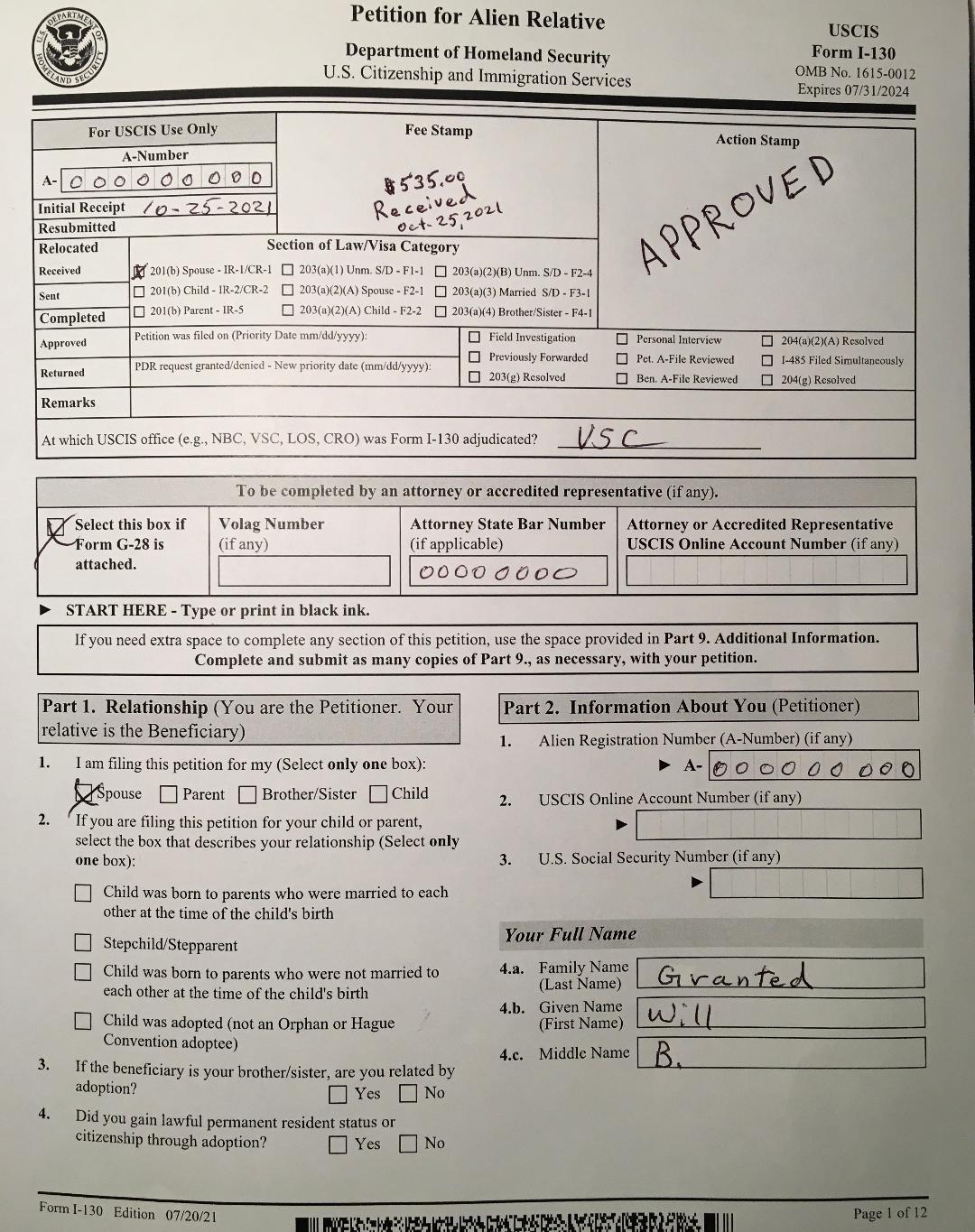
Generally speaking, an applicant for adjustment of status to lawful permanent resident based on marriage to a United States citizen must successfully complete a two-step process:
- Obtain an approved visa petition, in part, by establishing a bona fide marriage to the satisfaction of the United States Citizenship and Immigration Services (“USCIS”) pursuant to section 204(a)(1) of the Immigration and Nationality Act, as amended (“the Act”).
- Obtain approval of an adjustment of status application by establishing admission or parole, eligibility to receive a visa, admissibility as an immigrant and the immediate availability of an immigrant visa, pursuant to section 245(a) of the Act.
OCAHO

On September 1, 2021, OCAHO published a precedent decision relating to document fraud described in section 274C of the Immigration and Nationality Act, as amended. United States v. Zuniga Torentino, 15 OCAHO no. 1397 (2021).
OCAHO??Rejection of the “Inherently Unbelievable” Standard of Review of Motions to Reopen
%20Inherently%20Unbelievable.jpg "Rejection of the “Inherently Unbelievable” Standard of Review of Motions to Reopen")